
GST collections in March touched a record high of over Rs 1.23 lakh crore, a 27 per cent growth over the year-ago period, the Finance Ministry said on Thursday. "GST revenues crossed above Rs 1 lakh crore mark at a stretch for the last six months and a steep increasing trend over this period are clear indicators of rapid economic recovery post pandemic," the ministry said. Closer monitoring against fake-billing, deep data analytics using data from multiple sources including GST, income tax and customs IT systems and effective tax administration have also contributed to the steady increase in tax revenue over last few months, it added.

'There is a difference between a politician and leader.' 'A politician will have his pound of flesh first and do everything else later.' 'A leader will sacrifice everything to help people.'

Self-employed individuals often face hurdles in buying term insurance due to financial documentation that doesn't fully reflect their earnings. This complicates underwriting.

The Budget should use the extra RBI surplus to better effect, suggests A K Bhattacharya.

GST will also make our exports more competitive and also provide a level playing field to domestic industry to compete with imports, the President said.

Additional solicitor-general says extra-neutral alcohol liable to new tax

Dr Nagesh Kumar, one of the three new MPC members, wanted the MPC to reduce the repo rate by 25 basis points to 6.25%.

Shadow of elections may overshadow political consensus at GST Council meetings.

GST revenue for the month of June stood at Rs 92,849 crore, a 2 per cent increase over the same month a year ago, the Finance Ministry said on Tuesday. The gross GST revenue collected in the month of June 2021 stands at Rs 92,849 crore of which central GST is Rs 16,424 crore, state GST Rs 20,397, Integrated GST Rs 49,079 crore (including Rs 25,762 crore collected on import of goods) and cess is Rs 6,949 crore (including Rs 809 crore collected on import of goods), the ministry said. The GST revenues for the month of June 2021 are 2 per cent higher than Rs 90,917 crore collected in June 2020.

The heavy industries ministersaid that the proposal for the auto scrappage policy was ready and all stakeholders have provided inputs, therefore its announcement was likely very soon.
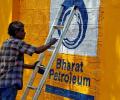
BPCL is a high revenue-earning public-sector undertaking (PSU) and plans to privatise it are completely off the table, Petroleum and Natural Gas Minister Hardeep Singh Puri said on Tuesday after assuming charge of the ministry for the second time. "Why would we divest ourselves of highly successful Maharatnas like BPCL," Puri said, arguing the Centre was not in favour of divesting its stake in oil PSUs.

The National Anti-Profiteering Authority has ordered FMCG major Nestle to deposit Rs 73.15 crore with Consumer Welfare Fund for not passing GST rate reduction benefit to consumers. Refuting the charges, Nestle said the benefits largely have been passed on by way of reduction of MRP or by way of increase in grammage.

The best way to achieve financial security isn't by cutting out every vada pav or limiting yourself to home-cooked meals; it's by making yourself indispensable at work, says Vatsal Ramaiya.

Does a doctor need to pay GST and other queries...

Currently, domestic supplies and commercial imports of vaccines attract a 5 per cent Goods and Services Tax, while COVID drugs and oxygen concentrators attract a 12 per cent levy.
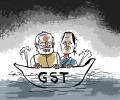
If the items and services such selected subsequently pass the test from the fitment committee and the GST Council, this would be the first of such rate hikes, after a series of cuts in the process of rate rationalisation that started in November 2017.

While SGBs are a sound investment, they aren't worth buying at any price. The interest income you earn from them will not justify paying a high premium.

The GST rate on mobile phones will be hiked to 18 per cent while that on maintenance repair overhaul (MRO) services for aircraft will be lowered to 5 per cent with effect from April 1, Finance Minister Nirmala Sitharaman said on Saturday. The GST rate on handmade and machine-made matchsticks has been rationalised to 12 per cent from 5 per cent and 18 per cent respectively.

The new restriction will be challenging for businesses, as they will have to do regular follow-ups with their suppliers.
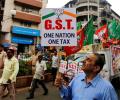
The 41st meeting of the GST Council, to be held via video conferencing, has just one agenda for discussion -- making up for shortfall in states' revenues, sources said.

'I am shocked that the BJP makes so many commitments. What did they deliver as the NDA?'

'There is global appreciation of the fact that India has the capacity and courage to carry out structural reforms like demonetisation and GST,' the finance minister said.

While Congress and the states ruled by non-NDA parties pushed for the Centre meeting its statutory obligation of covering the deficit, the Union government cited a legal opinion to say it had no such obligation if there was a shortfall in tax collections. The Centre as well as BJP-JD-U-ruled Bihar were of the opinion that the states should borrow to make up for the shortfall in the tax revenues that have been compounded by the COVID-19 crisis, sources said.
Some of the players in the GST race are Payworld, Dell, Tally Solutions

Taking both direct and indirect taxes, the gross collection is expected to grow 10.45 per cent to Rs 33.61 trillion in 2023-2024.

GST rates would depend upon whether the commodity is used by a rich person or a common man

High cost of acquisition due to a variety of reasons, including higher GST than all other major countries, is slowing down car demand in the country and unless the Centre and states take steps to reduce it, the industry is unlikely to experience reasonable growth, according to Maruti Suzuki India Chairman R C Bhargava. Addressing shareholders in the company's Annual Report for 2020-21, he said after the devastating second wave of the coronavirus pandemic hitting the first quarter of FY22, the performance in the next three quarters will largely depend on how effectively people get vaccinated and observe safety protocols.

Maharashtra government on Wednesday decided to acquire the iconic Air India building at Nariman Point in Mumbai for Rs 1,601 crore. The decision was taken at a meeting of the state cabinet in Mumbai. The meeting, chaired by Chief Minister Eknath Shinde, also decided to waive off around Rs 250 crore unrealised income and interest on the property, an official said.

He said the multi-party committee formed by the Speaker in Himachal Pradesh would discuss all issues about street vending on October 3. Singh's remarks came a day after the Congress top brass chided him over his remarks on mandatory display of names by the street vendors and told him that no one was allowed to go against the party's policies and ideologies.

India moving in right direction on GST, says Panagariya.

The former Congress chief accused Modi of 'diverting public attention' through various means.
Rates may be raised from 5 per cent to 8 per cent and 12 per cent to 15 per cent. The Council can explore possibility of merger of slabs to bring down the number of slabs to three. The Central GST collection fell short of the Budget Estimate by nearly 40 per cent during the April-November period of 2019-20

There is a need to incentivise R&D investments, offer corporate tax concessions and establish an effective intellectual property rights regime in order to push the growth of domestic pharmaceutical industry, as per the industry bodies. Outlining the sector's wish list for the upcoming Union Budget, Organisation of Pharmaceutical Producers of India (OPPI) Director General Anil Matai urged the government to explore methods to incentivise R&D investments, such as deductions on R&D expenses, research-linked incentives for MNCs, and corporate tax concessions.

While Union Finance Minister Nirmala Sitharaman reiterated her stand that the central government was committed to cooperative federalism, finance ministers of non-BJP ruled states such as Punjab and Kerala said she refused to give a categorical assurance that states will be paid compensation on time.

'The private sector believes that some enablers in labour-intensive sectors like apparel, toys, tourism, and media retail, can unlock a lot of jobs.'

Hospitality and travel sector players on Tuesday demanded infrastructure status for the hotel industry besides measures such as tax exemption on LTA annually to boost domestic tourism ahead of the Union Budget. They also recommended removal of the current TDS levied on automated bookings for internal or closed user groups such as business travel platforms and reducing the total number of licenses required to establish a hotel. "A full-blown infrastructure status for the hotel sector and further rationalisation of the Goods and Services Tax (GST) and a Central single window clearance for hotel projects are some of the major expectations from the Budget 2024," Roseate Hotels & Resorts CEO Kush Kapoor said in a statement.

However, India is likely to regain the tag of the fastest growth emerging economies of the world in 2018.
A well-functioning GST will enhance tax compliance and boost growth: IMF

Service companies such as Infosys, Tata Consultancy Services and Airtel, among others, would be particularly hit.

Here's everything you need to know about the Goods and Services Tax Bill.
 © 2026 Rediff.com - Advertise with us - Disclaimer - Privacy Policy - Sitemap - Feedback - About us - Terms of use - Grievances